.png)


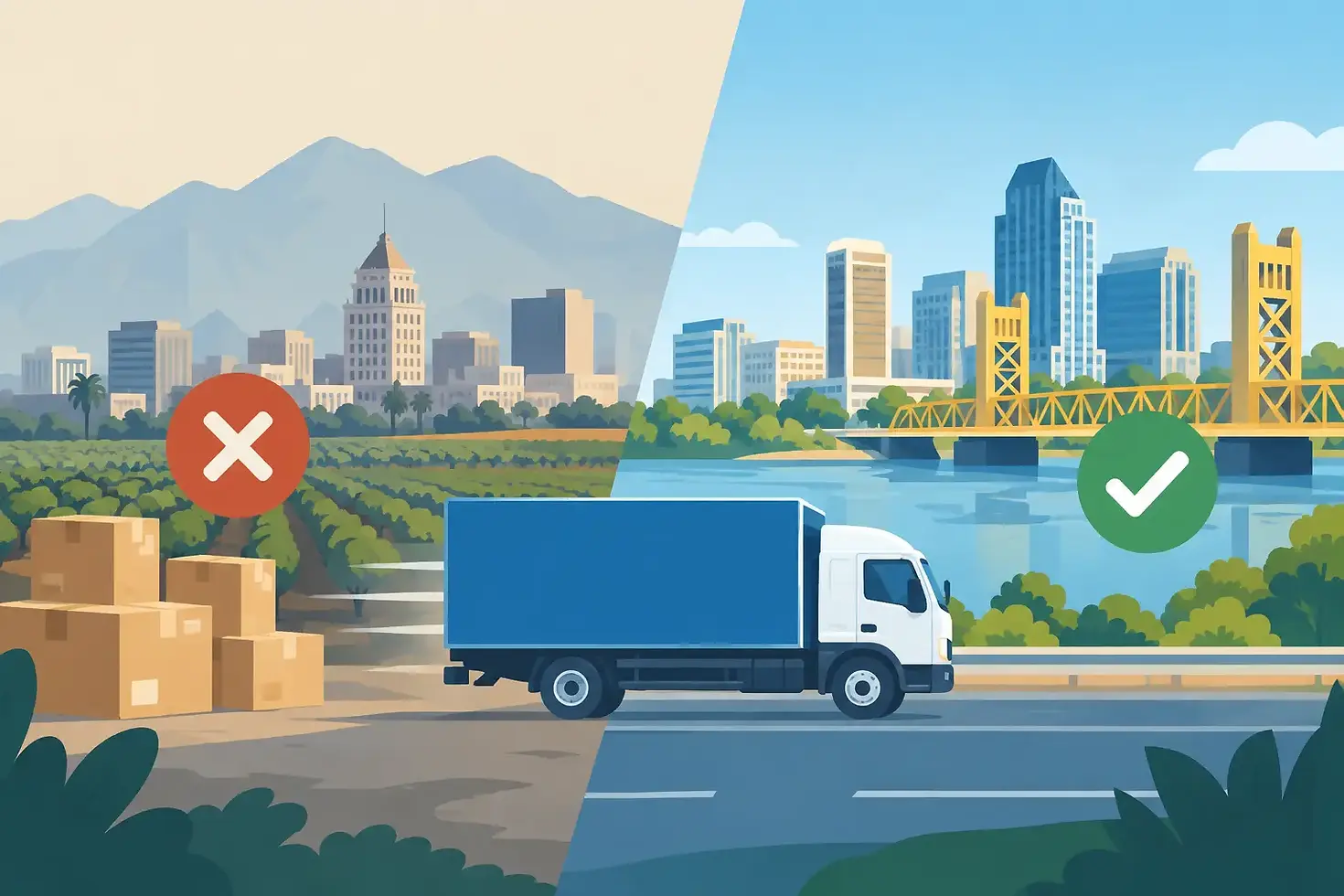
Why Fresno Is Hard to Ship From, Sacramento Makes Sense

Why Fresno Can Be a Difficult Place to Ship a Car From - and When Sacramento Makes More Sense
Fresno looks like it should be an easy place to ship a car from.
It sits in the middle of California's Central Valley, Highway 99 runs directly through the city, and Los Angeles, the Bay Area, and Sacramento are all within reach. But in auto transport, being centrally located on a map does not necessarily mean being centrally located on a carrier's route.
At Vice Auto Transport, we arrange vehicle shipping throughout California and across the country, and Fresno is one of those markets where a little flexibility can sometimes make a surprisingly big difference.
Fresno is absolutely serviceable for auto transport. Cars move in and out of the area every day. The challenge is finding a carrier whose existing route, available trailer space, timing, destination, and equipment all line up with your particular shipment.
When they don't, moving the pickup closer to Sacramento can sometimes create more carrier options, faster scheduling, or a better rate.
That doesn't mean you should automatically drive your car 170 miles north. Sometimes Fresno is exactly where we want to pick it up.
The trick is knowing when moving the pickup point actually helps.
Why Fresno Can Be Difficult for Car Shipping
Auto transport doesn't work like FedEx or UPS. There isn't necessarily a truck leaving Fresno every afternoon for Boston, Atlanta, Chicago, or New York.
A typical open auto carrier has a limited number of spaces and needs to build a profitable route around several pickups and deliveries. The driver has to consider fuel, available driving hours, vehicle sizes, delivery appointments, trailer space, and where the next load will come from.
That means a pickup can become harder to schedule when it pulls a driver away from the route they are already running.
We covered this in more detail in our guide- Why some car shipping routes are harder and more expensive than others.
Fresno is centrally located within California, but it isn't always a primary loading hub for long-distance auto carriers. Many drivers naturally gravitate toward dense vehicle markets and major interstate corridors where they can pick up and deliver several vehicles without adding unnecessary empty miles.
That doesn't make Fresno a bad pickup location. It simply means availability can vary more than customers might expect.
I-5 Carries More Long-Haul Traffic Than Highway 99
Fresno is closely tied to Highway 99, an important Central Valley corridor.
However, many long-haul carriers use Interstate 5 when moving between Southern California and Northern California or continuing toward Oregon and Washington.
Imagine a carrier already moving north on I-5 with one empty trailer position.
There might be several vehicles available around Sacramento or the Bay Area that fit the driver's next route. Picking up a Fresno vehicle may require the driver to leave the route they were already running, travel east, load one car, and reposition afterward.
That detour isn't necessarily huge.
But truck drivers don't look at one shipment in isolation. They're looking at the entire trailer.
If another vehicle fits their route better, requires fewer empty miles, and pays similarly, that's probably the car they're going to take.
This is one of the reasons a Fresno quote can be perfectly reasonable while pickup still takes longer than expected.
Lower Pickup Density Can Limit Trailer Matches
Large metropolitan areas give auto carriers choices.
A driver entering a major vehicle market might find several cars traveling in roughly the same direction. That allows the carrier to build a trailer efficiently instead of driving significant distances between individual pickups.
Fresno has a substantial population and active vehicle market, but it generally doesn't provide the same concentration of potential loads as Los Angeles, the Bay Area, or Sacramento.
That becomes especially important when you're shipping one vehicle to a less common destination.
The driver may be perfectly willing to pick up your car in Fresno once another nearby vehicle makes the route worthwhile. Until then, your shipment may be competing against cars that fit existing routes more efficiently.
This is also why we don't recommend choosing an auto transport company based entirely on whoever throws out the lowest number.
A cheap quote doesn't change where the trucks are.
Sometimes the Problem Is Your Street, Not Fresno
There's another issue customers don't always think about.
The carrier may have no problem coming to Fresno but still be unable to reach your actual pickup address.
A full-size car carrier can approach 75 feet in length. Neighborhoods with low tree branches, narrow streets, tight corners, steep inclines, parking restrictions, or limited turnaround space can make residential pickup difficult or unsafe.
That's why "door-to-door auto transport" doesn't always mean the truck will literally park in your driveway.
At Vice Auto Transport, if the carrier can't safely reach the address, we'll normally coordinate a nearby meeting point that works for both the customer and driver. A shopping center, large parking lot, wide commercial street, or truck-accessible location a few minutes away can solve the problem.
Being willing to meet the carrier nearby can sometimes open up options that disappear when a 9-car hauler has to navigate a difficult residential street.
When Sacramento Makes More Sense for Car Shipping
Sacramento isn't automatically a better pickup location.
If your vehicle is headed south toward Los Angeles or San Diego, or we find a carrier already working the Highway 99 corridor, Fresno may be exactly where the car should stay.
But Sacramento becomes interesting when moving the vehicle north puts it closer to a much larger pool of carriers and routes.
Sacramento Sits at a Strong Transportation Intersection
Sacramento connects I-5, I-80, Highway 50, and Highway 99.
That gives carriers several ways to combine Northern California pickups with routes heading north, south, east, or toward the Bay Area.
For a vehicle heading toward Nevada, the Pacific Northwest, Midwest, or East Coast, that can make Sacramento particularly useful.
A carrier doesn't necessarily need to be traveling directly from Sacramento to your destination. The driver may be assembling a multi-stop load and find that your vehicle fits neatly alongside several other Northern California pickups.
That's the important distinction.
We're not simply trying to find a truck.
We're trying to find the right truck whose existing route makes your car attractive to pick up.
More Vehicles Can Mean More Carrier Options
Sacramento's metro area generates personal vehicle shipments along with dealer, auction, fleet, online-purchase, and relocation traffic.
More vehicles moving through a market generally gives carriers more opportunities to build complete loads.
For a customer with a tighter pickup window, that can be valuable.
It doesn't mean moving the car to Sacramento guarantees next-day pickup. Auto transport doesn't work that way.
But putting the vehicle into a stronger carrier market can sometimes reduce the amount of time we're waiting for a truck whose route specifically fits Fresno.
It can also create additional options if you need coast-to-coast auto transport or specialized equipment for a valuable, modified, classic, or non-running vehicle.
Should You Drive Your Car From Fresno to Sacramento Just to Ship It?
Usually, not automatically.
This is where we think the numbers need to make sense.
Driving roughly 170 miles to save $50 on transport probably isn't a win once you account for fuel, mileage, your time, and figuring out how you're getting home.
Driving to Sacramento might make sense when:
You're already traveling north.
The seller or dealership is willing to meet there.
You have a very tight pickup deadline.
Carrier availability from Fresno is unusually limited.
The Sacramento option meaningfully improves the price or timing.
If none of those things apply, we'd usually start by trying to pick the vehicle up in Fresno.
For a non-running vehicle, classic car, collector vehicle, or anything you don't want to add mileage to, keeping the pickup in Fresno may make even more sense.
Just tell us exactly what we're dealing with.
If the vehicle doesn't run, steer, or brake normally, we need to know before dispatching it. That determines whether the carrier needs a winch or other loading equipment.
And if you're deciding between standard open transport and additional protection, our guide to open vs. enclosed auto transport explains when paying extra for enclosed shipping actually makes sense.
How to Make a Fresno Car Shipment Easier
The easiest thing you can give us is good information and a little flexibility.
We need accurate pickup and delivery ZIP codes, the year, make and model of the vehicle, its running condition, and the first date it will actually be available.
If the car has oversized tires, very low ground clearance, modifications, mechanical problems, extra parts traveling with it, or anything else unusual, tell us upfront.
Those details matter because not every vehicle fits every trailer.
A pickup window of a few days can also make a substantial difference. Instead of needing the one carrier who can arrive Tuesday afternoon, we can work with several trucks passing through the area over multiple days.
And if your street is difficult for a large truck, being willing to meet the driver somewhere accessible nearby makes everyone's life easier.
Price Matters - But So Does the Carrier Offer
This is another point worth understanding.
When you're comparing auto transport quotes, don't just ask what the broker is charging you.
If you're having trouble getting the vehicle picked up, ask:
"How much are you actually offering the carrier?"
That's one of the most useful questions a customer can ask.
If a broker quotes $1,200 but only offers $800 to the truck, the attractive customer quote isn't doing much good if carriers keep passing on the load.
On the other hand, if the broker is offering a competitive carrier rate and trucks still aren't accepting it, the problem may genuinely be the route, timing, equipment, or location.
That's when changing the pickup point, widening the window, or adjusting the carrier offer can actually solve something.
Fresno or Sacramento? Let the Route Decide
There isn't one answer that works for every shipment.
Fresno makes sense when the vehicle is already there, carrier availability is reasonable, the route fits Central or Southern California traffic, and you have some flexibility.
Sacramento may make more sense when the destination favors I-5 or I-80, the vehicle is already traveling north, your pickup window is unusually tight, or moving the car gives us access to a substantially better carrier pool.
At Vice Auto Transport, we'd rather look at the actual shipment before telling someone to drive nearly three hours just to make our job easier.
Sometimes Sacramento really does solve the problem.
Sometimes it saves virtually nothing and creates a giant pain in the ass for the customer.
And sometimes the best answer is simply paying the right carrier to pick the vehicle up exactly where it already sits in Fresno.
If you're shipping a vehicle from Fresno and aren't sure which option makes sense, send us the pickup ZIP code, destination ZIP code, vehicle information, and approximate dates. We'll look at the route and help you figure out the practical option.
Let Vice Auto Transport handle the miles.

Comments