

7 Best Ways to Ship Motorcycles Across Country

A cross-country ride can be the trip of a lifetime. A cross-country move, online purchase, military transfer, or seasonal relocation is different. When time, weather, miles, and wear on the bike matter, the best ways to ship motorcycles come down to matching the transport method to your motorcycle, schedule, destination, and budget.
Motorcycle shipping is not one-size-fits-all. A daily rider headed from Texas to Florida has different needs than a restored vintage bike going to California, or a motorcycle moving through a port to Hawaii, Puerto Rico, Guam, or the U.S. Virgin Islands. The right choice protects the bike without paying for services you do not need.
1. Use open motorcycle transport for practical, budget-conscious shipping
Open transport is the most common way to move a motorcycle within the continental United States. Your bike rides on an open trailer, usually with other motorcycles, and is secured with proper wheel chocks, straps, and tie-down points. Because the carrier can move several bikes at once, open shipping is generally the more economical option.
For standard motorcycles that are regularly ridden, open transport is often the best value. It works well for relocations, dealership deliveries, auction purchases, and long-distance moves when the bike does not require protection from normal road conditions.
The trade-off is exposure. The motorcycle may encounter rain, dust, wind, or road grime during transit, much like it would on a long ride. Professional carriers still secure the bike for travel, but open transport is not the best fit when a flawless show-ready finish is the priority.
2. Choose enclosed transport for collector, custom, and high-value bikes
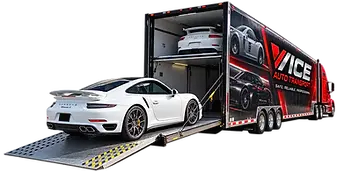
Enclosed shipping places the motorcycle inside a covered trailer. It provides more protection from weather, road debris, and outside visibility. For high-value motorcycles, custom builds, antiques, race bikes, and motorcycles with delicate paint or chrome, that added protection can be worth the higher price.
Enclosed transport also makes sense when shipping during winter or through areas likely to have severe weather. It does not eliminate every transportation risk, but it adds an important layer of protection from the elements.
Ask how the carrier secures motorcycles inside the trailer. A quality setup uses wheel chocks and motorcycle-specific tie-down procedures rather than treating the bike like general freight. If your motorcycle has a low fairing, unusual handlebars, limited ground clearance, or custom accessories, mention it before booking so the right equipment can be arranged.
3. Book door-to-door service when pickup access allows it
Door-to-door motorcycle shipping means the carrier picks up and delivers as close to your home, office, dealership, or agreed location as safely possible. For most customers, this is the simplest option. You avoid arranging a trip to a distant terminal and can inspect the motorcycle with the driver at pickup and delivery.
“Door-to-door” does not always mean a large truck can enter every residential street. Tight neighborhoods, low branches, steep driveways, gated communities, and narrow roads can limit access. In those cases, the driver may arrange a nearby meeting point such as a wide parking lot or shopping center.
That is not a service failure. It is a practical way to protect the truck, the property, and your motorcycle while keeping the handoff convenient. Clear communication about pickup access before dispatch prevents last-minute confusion.
4. Use terminal or depot options only when they solve a real scheduling issue
Terminal-to-terminal shipping can work when you cannot be available for pickup or delivery, or when your location is difficult for a carrier to access. The motorcycle is dropped at and collected from an approved facility rather than your address.
This option is not automatically cheaper, and it is not always available in every market. Storage time, operating hours, and facility procedures can affect the overall cost and convenience. For many customers, door-to-door service remains the easier choice because it reduces extra coordination.
A terminal can be useful when you are flying in to collect a purchased motorcycle, moving on a fixed schedule, or shipping from a dense urban area with limited truck access. Confirm who is authorized to release and pick up the bike, along with any storage charges if the motorcycle is not collected promptly.
5. Plan ahead for Hawaii, Alaska, and other offshore destinations
Shipping a motorcycle beyond the continental U.S. requires a different plan. Alaska, Hawaii, Puerto Rico, Guam, and the U.S. Virgin Islands may involve a combination of inland trucking and ocean freight. Your bike might move from your address to a departure port, then continue by vessel before final delivery or port pickup.
The best shipping plan depends on the origin, destination, vessel schedule, port rules, and whether you need door-to-port or port-to-door service. These moves usually require more lead time than a standard state-to-state shipment.
Motorcycles headed to a port commonly need to meet fuel and condition requirements. Many ocean carriers require a low fuel level and may have rules about loose items, alarms, or visible damage. Ask about these requirements early, especially if the bike has an oversized tank, aftermarket luggage, or nonstandard accessories.
Vice Auto Transport can arrange motorcycle movement across the continental U.S. and to non-contiguous destinations, helping coordinate the truck and port portions of the trip without leaving you to piece together the logistics alone.
6. Prepare the motorcycle before the carrier arrives
A smooth shipment starts before loading day. Preparation protects your motorcycle, makes inspection easier, and helps the driver load it safely. Do not wait until the truck is outside to discover a dead battery, flat tire, or missing key.
Before pickup, take these practical steps:
Wash the motorcycle so existing scratches, chips, or dents are easy to document.
Take clear, time-stamped photos from all sides, including close-ups of any existing damage.
Remove loose personal items, luggage, detachable electronics, and unsecured accessories.
Leave enough fuel to move the bike, but keep the tank low when required for port or ocean transport.
Check that the tires hold air, the battery works, and the bike can roll and steer. Tell the transporter in advance if it does not run.
Keep one set of keys available for the driver and retain a spare for yourself. If the motorcycle has special starting instructions, an alarm, a steering lock, or a hidden fuel switch, write down clear directions. Small details save time at pickup and delivery.
7. Compare quotes by service details, not just the lowest number
The lowest motorcycle shipping quote can look attractive until it leaves out key details. Price matters, but it should be considered alongside transport type, carrier availability, pickup window, insurance documentation, and delivery expectations.
When comparing quotes, make sure each company is pricing the same service. An open carrier quote should not be compared directly to enclosed transport. Door-to-door delivery may cost more than terminal service, while a remote area, oversized motorcycle, inoperable bike, or expedited timeline can affect the rate.
Ask whether the quote accounts for the motorcycle's make, model, modifications, and exact pickup and delivery ZIP codes. Be honest about non-running condition, extended handlebars, trikes, sidecars, and oversized luggage. Surprises at loading can cause delays or require different equipment.
You should also understand the delivery window. Interstate transport is affected by traffic, weather, route changes, legal driving-hour limits, and the timing of other pickups and deliveries. A professional transport coordinator will give you realistic expectations rather than promise an exact arrival time that road conditions cannot guarantee.
What makes a motorcycle shipping method the right one?
The right method is the one that fits the bike and the move. Open transport is usually the practical choice for a standard motorcycle and flexible budget. Enclosed transport offers greater protection for valuable or highly customized bikes. Door-to-door service reduces work for most shippers, while port coordination is essential for Hawaii, Alaska, Puerto Rico, Guam, and the U.S. Virgin Islands.
Start with the motorcycle's value, condition, destination, and the date it truly needs to arrive. Then choose a shipping plan that gives the bike appropriate protection and gives you clear answers from pickup through delivery.


Comments