

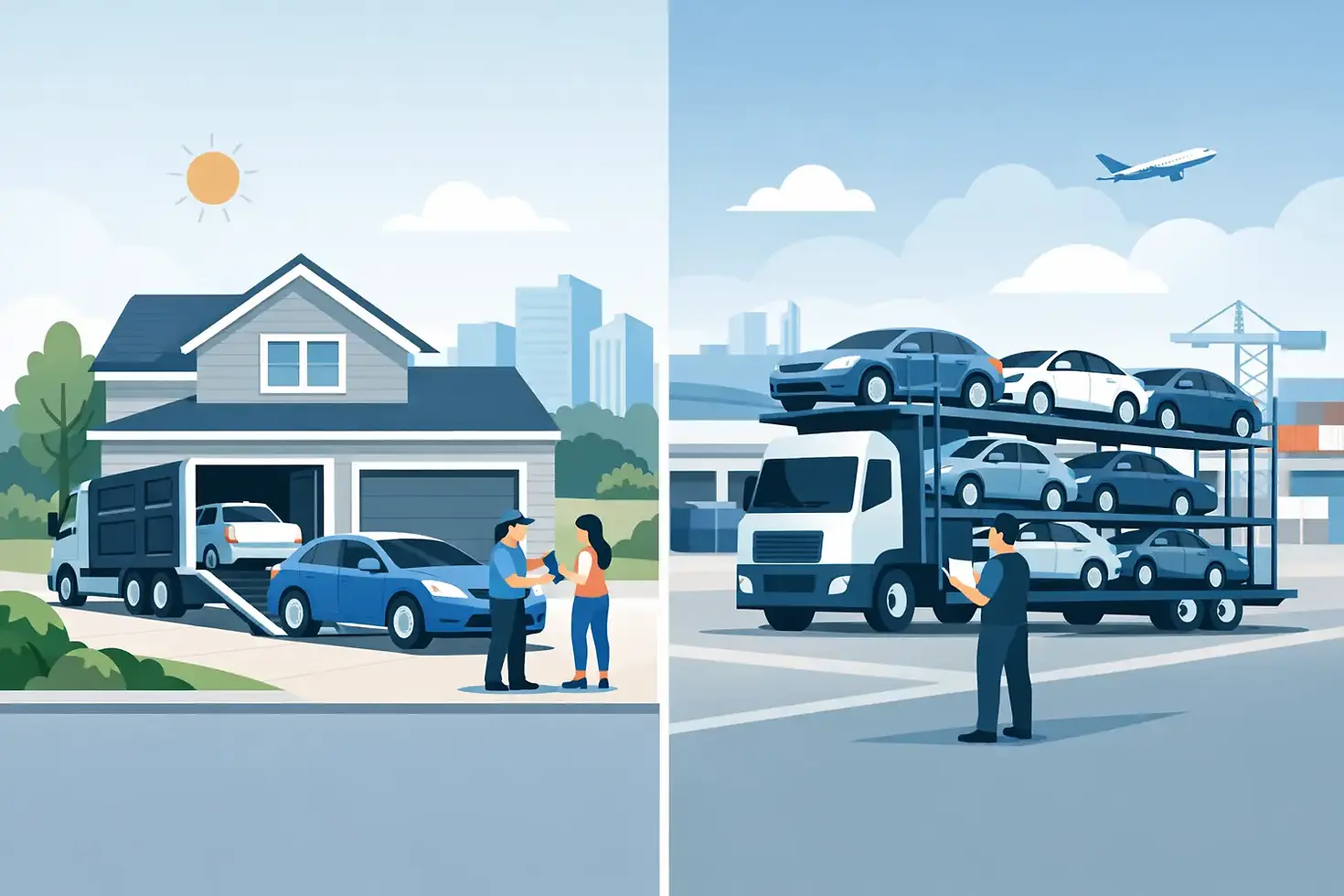
Door to Door vs Terminal Auto Transport
- Shawn Anderson

- Jun 10
- 6 min read
If you are comparing door to door vs terminal auto transport, the real question is usually simpler: do you want maximum convenience, or are you trying to shave off some cost and work around a tighter pickup setup? Both options can move a vehicle safely. The difference is how much of the coordination lands on the carrier and how much lands on you.
For most people shipping a car today, door-to-door service is the easier fit. It is the standard option in much of the market because it saves time and cuts down on extra driving. Terminal shipping still has a place, though, especially when schedules, storage needs, or access issues make a fixed handoff point more practical.
Door to door vs terminal: what each one means
Door-to-door auto transport means the carrier picks up your vehicle as close to your home, office, dealership, auction, or other requested address as safely and legally possible. Delivery works the same way. The truck comes to you, or to the nearest practical meeting point if your street has low branches, tight turns, weight restrictions, or neighborhood access limits.
Terminal transport means your vehicle is dropped off at a designated lot, yard, or shipping terminal before transport, then picked up from another terminal near the destination. Instead of waiting at your address, you handle the first and last leg yourself. That can mean arranging a ride, driving to the terminal, and working around that facility's hours and procedures.
This is why the comparison is not just about price. It is also about access, flexibility, storage, timing, and how much extra effort you want to take on.
Why door-to-door is usually the better fit
Door-to-door service works well because it matches how most customers actually ship vehicles. Families relocating do not want to add two extra terminal runs to an already busy move. Online car buyers want the vehicle brought close to home, not left at a facility across town. Dealers and fleet managers often need deliveries coordinated around business hours and staff availability.
There is also less chance of communication gaps when the move is handled from one address to another. You know where the car is being picked up. You know where it is going. If a truck cannot safely access the exact location, the driver and customer usually arrange a nearby large parking lot or open commercial area. That still feels much closer to a full-service move than terminal shipping.
For customers shipping to or from more complex locations, including ports or non-contiguous areas, direct handoff options can also simplify the process. A service-driven company like Vice Auto Transport often works with customers who need practical routing, not a one-size-fits-all answer.
When terminal transport can make sense
Terminal shipping is not outdated just because door-to-door is more common. In some cases, it is the cleaner option.
If you live on a narrow mountain road, inside a dense downtown block, or in a neighborhood where commercial trucks are hard to get in and out of, a terminal can remove some of the pickup headaches. It can also help if you are not available for the carrier's pickup window and want a facility to receive or hold the vehicle.
Some customers use terminal service because they are traveling and cannot meet a driver in person. Others want a more fixed drop point during a move when their housing situation is still in flux. In those cases, the terminal acts as a buffer.
The trade-off is obvious. You are giving up convenience in exchange for structure. Depending on the route and facility, that may or may not save money.
Cost differences are real, but not always dramatic
A lot of people assume terminal shipping is always much cheaper. Sometimes it is. Sometimes it is not enough of a difference to justify the extra time and driving.
Pricing depends on route demand, season, vehicle size, trailer type, distance, and how easy the car is to reach. If door-to-door pickup requires a major detour or a difficult residential approach, that can raise the rate. On the other hand, if the terminal is far from the carrier's route or involves added handling, the savings may be smaller than expected.
This is where practical quoting matters. The cheapest-looking option on paper can create extra costs in gas, rideshare trips, missed work, storage fees, or delays. For a customer shipping one daily driver, paying a little more for direct pickup and delivery often makes better financial sense overall.
For dealerships, auctions, or volume shippers, terminal use may fit an existing workflow. For individual households, the math is usually different.
Timing and scheduling are different with each option
Door-to-door service tends to be more straightforward, but it still works within real trucking schedules. Pickup and delivery are usually arranged in windows, not exact minute-by-minute appointments. Traffic, weather, route changes, and federal driving limits all matter.
Terminal shipping can offer a different kind of timing flexibility. You may be able to drop off earlier or pick up later, depending on the facility. That can help if your own schedule is the main issue. But terminal moves can also introduce waiting time if the car arrives before you do, or if the terminal has limited receiving hours.
Neither option is automatically faster. On a strong route with good carrier availability, door-to-door may move quickly. In another case, terminal coordination could work better if it helps line up the shipment sooner. The best choice depends on the lane and your schedule tolerance.
Access issues matter more than most customers expect
One of the biggest reasons people end up discussing door-to-door vs terminal service in detail is truck access. A full-size car hauler is not a pickup truck with a trailer. It needs room to turn, park, load, and leave safely.
If you live in a subdivision with tight corners, overhanging trees, low wires, steep grades, or HOA restrictions, the carrier may not be able to reach your exact driveway. That does not automatically mean you need terminal shipping. In many cases, door-to-door still works with a nearby meeting point such as a grocery store lot, truck-friendly retail area, or open side street.
That is an important distinction. Door-to-door does not always mean tire-to-tire service at your front porch. It means the carrier comes as close as is safely possible without creating risk to the truck, your vehicle, or the neighborhood.
Which option is better for different types of customers?
For first-time shippers, door-to-door is usually the easiest to manage. It reduces moving parts and gives you a simpler handoff process. If you are relocating, buying a car online, sending a vehicle to a family member, or shipping a seasonal car, convenience usually wins.
For dealerships and commercial clients, either option can work depending on workflow. A business with staff, lot space, and regular receiving procedures may be comfortable with terminal-based coordination. A smaller operation may prefer direct delivery to keep vehicles moving.
For collector cars, high-value vehicles, or specialty units, customers often focus more on equipment type than terminal access alone. Enclosed transport, flatbeds, and specialized trailers may matter more than whether the first handoff happens at a residence or a facility.
For Alaska, Hawaii, Puerto Rico, Guam, or the U.S. Virgin Islands, the conversation can shift again. Customers may compare door-to-port, port-to-door, and related handoff arrangements rather than a standard mainland residential move. The same rule still applies: the right option depends on convenience, route realities, and how much coordination you want to handle yourself.
How to choose without overthinking it
If your home or business is reasonably accessible and you want the least hassle, choose door-to-door. That is the answer for most customers.
If you need a holding point, cannot meet the driver easily, or your location is difficult for a transporter to access, ask about terminal service or a nearby truck-friendly meetup location. The best solution may be somewhere in the middle.
The smartest way to decide is to look at your actual route, your availability, and your pickup location - not just the headline price. A good transport setup is not the one that sounds best in theory. It is the one that fits your address, your timing, and your budget without creating extra work at the worst moment.
If you are unsure, ask for both scenarios and compare them side by side. A clear answer usually shows up fast once you see the real numbers and the real pickup plan.

Comments