.png)


Are Residential Pickups Allowed for Auto Transport?

Are Residential Pickups Allowed for Auto Transport? How Door-to-Door Car Shipping Really Works
Can a car carrier pick up your vehicle directly from your house?
Usually, yes.
Residential pickups are allowed for auto transport in many neighborhoods, and home pickup is a normal part of door-to-door car shipping. But "door-to-door" does not mean a driver is required to put a 75-foot auto transport truck anywhere a passenger vehicle can go.
The carrier will make a good-faith effort to pick up and deliver your vehicle as close to the requested addresses as safely and legally possible.
For many customers, that works exactly as expected. The driver calls ahead, arrives on the street, inspects the vehicle with you, loads it, and heads out.
For others, the safest option is meeting the carrier a few minutes away at a shopping center, wide gas station, truck stop, commuter lot, or another truck-friendly location.
That is still door-to-door auto transport as the term is commonly used in the industry. It is not a downgrade in service.
In many situations, it is simply the safest option for your vehicle, the carrier, and your neighborhood.
Are Residential Pickups Allowed for Auto Transport on Every Street?
Residential vehicle pickups are generally possible when the street can accommodate the carrier and local restrictions do not prevent commercial truck access.
The important distinction is between whether a carrier can reach your neighborhood and whether it can safely reach your exact driveway or curb.
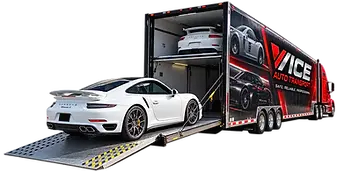
Most open auto transport trailers are large commercial vehicles. Enclosed carriers can be just as long, and some are taller.
Narrow roads, sharp turns, low tree branches, tight cul-de-sacs, parked cars, steep grades, low bridges, and restricted entrances can make pickup directly in front of a house impractical.
The driver also has to consider whether stopping the truck would block traffic, create a safety problem, or violate local commercial-vehicle restrictions.
Even when a truck can physically fit down a street, that does not necessarily mean it should.
A loaded auto carrier needs enough space to approach the location, position the trailer for loading, operate its ramps or hydraulic equipment, and safely leave afterward.
Nobody wants to discover after turning onto a residential street that there is nowhere for a loaded car carrier to turn around.
What Types of Neighborhoods Are Usually Easier?
A suburban neighborhood with broad streets, sufficient clearance, and through-roads may be straightforward for a carrier.
A downtown apartment building, historic district, gated community, mountain road, narrow urban neighborhood, or tight cul-de-sac is more likely to require an alternative meeting point.
The answer therefore isn't simply yes or no.
Residential pickup is common.
Whether the truck can stop directly in front of your home depends on the actual location and the equipment being used for your shipment.
What Does Door-to-Door Auto Transport Really Mean?
Door-to-door auto transport means the carrier coordinates pickup and delivery around the addresses you provide rather than requiring you to take the vehicle to a distant shipping terminal.
The carrier attempts to get as close to those addresses as safely and legally possible.
That distinction prevents a lot of frustration.
A good auto transport company should not promise that a multi-car carrier will pull directly into your driveway without knowing anything about the neighborhood.
If direct truck access isn't practical, you and the driver can coordinate a nearby location with enough room to safely load or unload the vehicle.
That location is usually only a short distance away.
The final decision may sometimes happen on pickup or delivery day because the assigned driver knows the dimensions of the specific truck and trailer, current traffic conditions, local restrictions, and the approach to your address.
That is normal.
A driver asking to meet nearby because the truck cannot safely reach your house is not automatically a red flag or evidence that your shipment was mishandled.
It can actually be a sign that the driver is taking the equipment, vehicle, and surroundings seriously.
Signs You May Need a Nearby Pickup Location
You do not need to understand commercial trucking regulations or know the turning radius of an auto carrier.
Take a look at your neighborhood and ask a simpler question:
Could a very large truck enter this street, pass the parked vehicles, stop without creating a hazard, turn around, and leave comfortably?
Potential problems include:
Small cul-de-sacs or dead-end streets
Heavy on-street parking
Narrow residential roads
Low-hanging trees
Steep hills or driveways
Gated entrances
HOA or commercial-truck restrictions
Tight corners
Low bridges or overhead clearance
Apartment parking garages
Limited loading areas
If several of those describe your location, planning a nearby meeting point may be easier than attempting pickup directly at the residence.
Rural Residential Pickups
Rural addresses present a different set of challenges.
A large carrier may have difficulty with a long gravel driveway, narrow bridge, soft shoulder, winding road, weight restriction, or an area without enough room to turn around.
That doesn't necessarily make the shipment difficult.
The driver may simply meet you near a main road, at the entrance to the property, in a nearby town, or at a convenient highway-adjacent location.
Apartment and Condo Pickups
Apartment and condominium complexes can also require additional planning.
Parking garages usually aren't suitable for large auto carriers, and some developments have gates, tight internal roads, restricted commercial access, or limited space around the entrance.
Meeting the driver in a nearby open parking area is often easier than attempting to bring the carrier inside the complex.
How to Choose a Good Auto Transport Meeting Point
The best meeting point is close to your requested address, public, safe, and easy for a large truck to enter and exit.
Common options include large shopping centers, grocery store parking lots, truck stops, wide gas stations, commuter lots, and other open commercial areas.
The goal is not to make you drive across town.
It is to avoid putting a large carrier into a location where the driver risks damaging property, blocking traffic, getting stuck, or losing significant time trying to maneuver.
Ask the assigned driver where they prefer to meet.
The driver understands the trailer's size, turning radius, loading requirements, and approach route better than anyone else involved in the shipment.
Low-Clearance and Specialty Vehicles Need Extra Room
The meeting location becomes particularly important for exotic, classic, modified, or low-clearance vehicles.
Loading ramps need sufficient room, and a steep driveway or uneven surface can create unnecessary problems for a vehicle with a low front splitter or reduced ground clearance.
Enclosed transportation does not eliminate those concerns.
Some enclosed carriers use hydraulic liftgates or specialized loading equipment, but the truck still needs a suitable area to operate that equipment safely.
If you're deciding whether a specialty vehicle needs open or enclosed service, read our guide on whether enclosed auto transport is worth it for your car.
What Happens During a Residential Vehicle Pickup?
Once the driver reaches the agreed pickup location, the process is relatively straightforward.
You or another authorized adult meets the driver and provides the keys.
Before loading, the driver inspects the vehicle and records its existing condition on the Bill of Lading.
Visible scratches, dents, chips, and other existing cosmetic damage should be documented.
Take your own clear, dated photographs as well.
Photograph each side of the vehicle along with the wheels, windshield, bumpers, roof, and any existing damage.
This is sensible documentation and does not mean you should expect something to go wrong.
The vehicle is then loaded and secured to the carrier.
How Much Fuel Should Be in the Vehicle?
Approximately one-quarter tank is generally enough.
The vehicle only needs enough fuel for loading, unloading, and minor repositioning.
There is no advantage to filling the tank immediately before shipping, and the additional fuel adds unnecessary weight.
Can You Leave Personal Items in the Car?
The safest approach is to ship the vehicle without unnecessary personal belongings.
Some carriers may permit a limited amount of personal property at their discretion, but those belongings generally are not covered by the carrier's cargo insurance.
Additional weight can also create problems for the carrier.
Remove valuables, toll tags, loose accessories, and anything you don't need inside the vehicle during transportation.
What If the Vehicle Doesn't Run?
Inoperable vehicles can be transported, but tell your transport coordinator before a carrier is assigned.
Simply saying the car "doesn't run" isn't enough information.
We need to know:
Does it start?
Does it roll?
Does it steer?
Do the brakes work?
A vehicle that doesn't start but rolls, steers, and brakes can often be loaded by a winch-equipped carrier.
A collision-damaged vehicle with locked wheels, missing tires, damaged suspension, or steering problems can require substantially different equipment or loading assistance.
Surprises at pickup can result in delays, additional charges, or a carrier being unable to load the vehicle at all.
The same principle applies to modifications.
Tell your transport coordinator about very low ground clearance, oversized tires, lift kits, roof racks, spoilers, fluid leaks, unusual starting procedures, or anything else that could affect loading.
Accurate information helps match the vehicle with appropriate equipment.
Residential Pickup for Dealer, Auction and Online Vehicle Purchases
Not every door-to-door shipment begins at someone's home.
The same basic access rules apply when a vehicle is being collected from a dealership, private seller, auction facility, storage lot, or business.
Dealerships may have designated areas for transport trucks.
Private sellers need to know when the carrier is expected and should have the keys and vehicle ready.
Auction facilities can have specific gate hours, release procedures, lot numbers, storage deadlines, and loading requirements.
If you're buying a vehicle from Copart, IAA, Manheim, or another auction, give your transport coordinator the release information and accurate vehicle condition before dispatch.
A great transportation plan can't overcome a vehicle that isn't actually available when the carrier arrives.
Timing and Communication Matter More Than Getting the Truck to Your Curb
Most customers ultimately care less about whether the truck stops directly in front of their mailbox than whether the vehicle is picked up professionally and on time.
That comes down to communication.
Pickup windows are common in auto transport because carriers are coordinating several vehicles while dealing with traffic, weather, customer availability, loading time, and federal driving-hour requirements.
Stay reachable as your pickup window approaches.
If you cannot be present, arrange for a trusted adult to release the vehicle and sign the paperwork.
That person should have the keys, understand the vehicle's condition, and be able to communicate with the driver.
A driver may call with an updated arrival time and then ask to meet nearby because of unexpected street congestion, construction, low branches, or another access problem.
A little flexibility on the meeting location can keep the shipment moving without compromising safety.
How to Make Residential Auto Transport Pickup Easier
Give your transport coordinator the complete pickup and delivery addresses once you book.
Mention gates, narrow roads, apartment complexes, HOA restrictions, steep driveways, parking limitations, low branches, or anything else the driver should know.
If you already suspect that a large truck won't fit, say so.
It is much easier to plan a nearby meeting location in advance than to solve the problem while the carrier is sitting outside the neighborhood.
On pickup day, have the vehicle accessible and ready.
Keep your phone nearby, make sure the keys are available, and if you're meeting the driver away from your home, leave enough time to arrive before the carrier.
Real People Help When Pickup Plans Change
Residential pickup is one of those parts of auto transport where having an actual person to contact matters.
An online quote form cannot see the low branches over your street.
It doesn't know that your gated community won't allow commercial trucks after 5 p.m., that construction closed the easiest entrance to your neighborhood, or that your apartment garage has an eight-foot clearance.
Those details often don't become apparent until the shipment is being coordinated.
Vice Auto Transport puts a strong emphasis on live support from dedicated transport professionals.
If the driver needs a different meeting point, your pickup contact changes, the vehicle isn't ready, or another issue comes up, you can call or text someone who understands the shipment and can help coordinate the next step.
Technology makes auto transport easier.
It shouldn't leave you alone when something changes.
Real reviews, real people answering the phones, we're here to help, no worries.
So, Are Residential Pickups Allowed for Auto Transport?
Yes, residential auto transport pickup is common and works perfectly well for many customers.
The important qualification is that the carrier needs safe and legal access.
If the truck can reach your residence without creating a safety, clearance, traffic, or maneuvering problem, pickup may happen directly in front of your home.
If it can't, you and the driver can arrange a nearby truck-friendly meeting point.
Either way, you can still receive door-to-door auto transport service without taking your vehicle to a distant terminal.
The goal isn't to get a 75-foot truck underneath your mailbox at all costs.
The goal is to load your vehicle safely, communicate clearly, and get it moving toward its destination.
Need Help Planning a Residential Vehicle Pickup?
If you're unsure whether an auto carrier can reach your home, apartment, dealership, auction, or other pickup location, give Vice Auto Transport the actual addresses and vehicle information.
We can help you identify potential access concerns and coordinate a practical pickup plan with the assigned carrier.
Call: 1-800-541-0696
Vice Auto Transport — Let Us Handle the Miles.


Comments