.png)


Ship a Golf Cart or ATV State to State: Open or Enclosed

How to Ship a Golf Cart or ATV From State to State: Open vs. Enclosed Transport
Shipping a golf cart or ATV from state to state starts with one practical question: what kind of trailer can safely accommodate your vehicle?
A golf cart headed to a Florida retirement community, an ATV purchased from an out-of-state dealership, or a side-by-side moving with a family can all be transported across state lines.
But these vehicles aren't always handled the same way as a standard passenger car.
Golf carts, ATVs, UTVs, and side-by-sides can have unusual dimensions, specialized tires, modified suspensions, exposed accessories, or loading requirements that affect which carriers can transport them.
The right solution depends on the vehicle's dimensions, condition, value, route, timing, and whether open or enclosed transportation makes more sense.
Here's what to know before booking.
Can You Ship a Golf Cart or ATV Across State Lines?
Yes. Golf carts, ATVs, utility terrain vehicles (UTVs), and side-by-sides can be transported between states using properly equipped trailers.
However, not every auto transport carrier accepts these vehicles.
A carrier primarily hauling standard sedans and SUVs may not have suitable ramps, securement equipment, trailer space, or insurance arrangements for a particular recreational vehicle.
That's why accurate vehicle information matters before dispatch.
Golf Carts
Golf carts are commonly transported for:
Seasonal homes and retirement communities
Golf courses and resorts
Private residential communities
Vacation properties
Dealership purchases
Family relocations
Standard two-passenger carts may be relatively straightforward to load.
Larger four- and six-passenger models, lifted carts, and customized vehicles can require additional space and equipment.
ATVs and Four-Wheelers
ATVs are generally compact off-road vehicles, but dimensions and weights vary.
Some are small enough for a suitable utility trailer, while larger or modified models require more careful equipment matching.
Carriers need to know whether the ATV starts, rolls, steers, and brakes.
UTVs and Side-by-Sides
Side-by-sides can be significantly larger than standard ATVs.
Models from manufacturers such as Polaris, Can-Am, Honda, Kawasaki, and Yamaha may have wide stances, tall roll cages, roofs, aftermarket bumpers, and oversized tires.
A lifted side-by-side with a roof and light bar can create clearance problems even when its overall length appears manageable.
Provide the exact model and actual dimensions, including modifications.
Open vs. Enclosed Trailer Transport for Golf Carts and ATVs
Both open and enclosed trailers can be used for interstate golf cart and ATV transportation.
Neither is automatically the right choice for every shipment.
The decision should be based on vehicle dimensions, loading requirements, protection needs, and available carrier equipment.
Open Trailer Transport
Open transport means the golf cart or ATV travels on an uncovered trailer.
The vehicle is secured for highway transportation but remains exposed to rain, dust, road grime, and other normal environmental conditions.
Open transport is often the more economical choice when suitable equipment is available.
It's commonly considered for:
Standard golf carts
Everyday recreational ATVs
Utility vehicles
Farm and property-use vehicles
Non-collectible side-by-sides
Vehicles already designed for outdoor use
For example, a standard golf cart being shipped from Georgia to a seasonal home in Florida may not require the additional weather protection of an enclosed trailer.
Likewise, an ATV purchased for regular trail riding may be a good candidate for open transport.
However, the trailer must still be appropriate for the vehicle.
A standard multi-car hauler isn't necessarily the best choice for a narrow ATV or a golf cart with unusual loading requirements.
Some shipments may be better suited to a smaller equipment trailer, flatbed, or specialized vehicle transporter.
Enclosed Trailer Transport
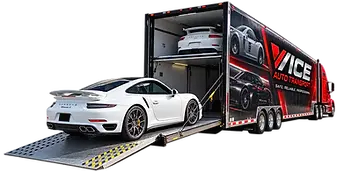
Enclosed transportation places the vehicle inside a covered trailer.
It provides additional protection from weather, road spray, airborne debris, and public exposure during transit.
Enclosed shipping may be preferable for:
Restored vintage golf carts
Custom-painted carts
High-value side-by-sides
Collector ATVs
Specialty recreational vehicles
Vehicles with expensive exposed accessories
Show-quality or promotional vehicles
A custom golf cart with premium upholstery, specialty wheels, and a detailed paint finish may justify enclosed transportation.
The same may be true for a heavily customized side-by-side with expensive accessories.
But enclosed doesn't automatically mean suitable.
The carrier still needs adequate interior height, width, loading clearance, and securement points.
Some enclosed trailers are designed primarily for cars and may not accommodate a tall UTV or lifted golf cart.
Does Enclosed Transport Eliminate Damage Risk?
No.
Enclosed trailers reduce exposure to outside conditions, but proper loading and securement remain essential.
A poorly secured vehicle can still be damaged inside a covered trailer.
Carrier qualifications, equipment suitability, insurance information, and documented inspections matter regardless of trailer type.
For more information about the general differences, see our guide on whether enclosed auto transport is worth it.
How Much Does It Cost to Ship a Golf Cart or ATV?
There is no universal flat rate for interstate golf cart or ATV transportation.
Pricing depends on the actual vehicle, route, equipment requirements, and available carrier capacity.
A compact, running ATV traveling between two major metropolitan areas may be easier to accommodate than a wide, non-running side-by-side headed to a remote rural destination.
Distance and Route
Distance is an important factor, but route density matters too.
A golf cart moving from Tampa to Dallas may have more potential transportation opportunities than one traveling between two isolated rural communities.
Common recreational and seasonal markets include Florida, Arizona, Texas, California, and parts of the Southeast.
However, carrier availability depends on the specific route and equipment required.
Vehicle Dimensions and Weight
Provide accurate measurements for:
Overall length
Overall width
Overall height
Approximate weight
Ground clearance
Tire size
Roof or roll-cage height
Include any aftermarket modifications.
A lifted golf cart with oversized tires and an extended roof can occupy substantially more trailer space than a standard two-passenger cart.
A side-by-side with wide suspension components may exceed the usable width of certain trailers.
These details can affect both pricing and carrier eligibility.
Running vs. Non-Running Condition
A vehicle that starts, rolls, steers, and brakes is generally easier to load.
A non-running ATV or golf cart may require a winch or specialized loading equipment.
If the wheels are locked, the steering is damaged, or the vehicle cannot roll freely, disclose that before booking.
Non-running units can often be transported, but the carrier needs to know what equipment is necessary.
Seasonal Demand and Fuel Costs
Seasonal demand can affect golf cart and recreational vehicle shipments, especially on routes involving Florida and Arizona.
Fuel prices also influence carrier operating expenses.
Our article on how rising diesel prices affect auto transport costs explains how those costs influence long-distance shipping rates.
Shipping an Electric Golf Cart vs. a Gas-Powered Golf Cart
One detail that deserves special attention is the vehicle's power source.
Electric golf carts and gas-powered golf carts have different preparation considerations.
Electric Golf Cart Shipping
Electric carts may use lead-acid or lithium-ion batteries.
Tell your transport coordinator which type your vehicle uses.
Battery chemistry, condition, and configuration can affect whether a carrier is willing or equipped to accept the shipment.
For electric carts:
Confirm the battery is properly secured.
Disclose damaged, leaking, or malfunctioning batteries.
Provide the driver with operating instructions.
Make sure the cart has enough charge for loading and unloading.
Explain how to release the parking brake.
Identify any manufacturer-specific transport or tow mode.
Some golf carts have switches or operating procedures intended for storage or towing.
Follow the manufacturer's instructions and the carrier's requirements rather than assuming every electric cart operates the same way.
Do not disconnect batteries or modify electrical systems unless instructed by the manufacturer or a qualified professional.
Damaged or defective lithium batteries may require specialized handling and may not be accepted for ordinary vehicle transportation.
Gas-Powered Golf Cart Shipping
For gas-powered carts, keep the fuel level low rather than transporting the vehicle with a full tank.
Make sure there are no active fuel or fluid leaks.
Secure the fuel cap and provide the driver with any unusual starting instructions.
The carrier may have specific fuel and preparation requirements, so confirm those before pickup.
How to Prepare a Golf Cart, ATV, or Side-by-Side for Transport
Good preparation helps prevent loading problems and makes condition inspections easier.
Photograph the Vehicle
Clean the vehicle enough to inspect its exterior.
Take clear photographs showing:
Front and rear
Both sides
Wheels and tires
Roof and windshield
Seats and body panels
Existing scratches or cracks
Aftermarket accessories
Keep copies of the photos for your records.
Remove Loose Accessories
Remove or securely stow items such as:
Coolers
Tools
Detachable storage boxes
Loose cargo
Personal belongings
Unsecured windshields
Removable accessories
Check that doors, roofs, mirrors, and light bars are firmly attached.
A tall roof or mounted accessory can affect trailer clearance, so disclose it even if it cannot be removed.
Check the Vehicle's Operating Condition
Make sure the carrier knows:
Whether the vehicle starts
Whether it rolls freely
Whether it steers
Whether the brakes work
Whether the tires hold air
Whether a working key is available
If the vehicle has a special ignition sequence, wheel lock, parking-brake procedure, or remote, explain it to the driver.
A few minutes of preparation can prevent a significant loading delay.
Can You Ship a Lifted Golf Cart or Modified Side-by-Side?
Yes, provided a suitable carrier and loading arrangement can be found.
Modified recreational vehicles require more careful planning than standard factory configurations.
Common modifications include:
Lift kits
Oversized tires
Extended roofs
Custom suspension
Wide wheel spacers
Roof-mounted lights
Windshields and doors
Aftermarket bumpers
Cargo racks
These modifications may affect the vehicle's actual dimensions, weight, ground clearance, and loading angle.
Do not rely only on factory specifications when requesting a quote.
For example, a factory side-by-side may fit a particular enclosed trailer, while the same model with aftermarket suspension and a tall roof may not.
Accurate measurements help avoid a carrier arriving with equipment that cannot safely accommodate the vehicle.
Golf Cart and ATV Pickup and Delivery: What to Expect
Interstate golf cart and ATV transportation typically follows a similar process to standard vehicle shipping.
However, loading arrangements may differ depending on the trailer and equipment.
Door-to-Door Transport
Door-to-door service generally means the carrier gets as close to the pickup and delivery addresses as safely and legally possible.
It does not guarantee that a large trailer can enter every driveway, gated community, or narrow residential street.
A nearby accessible meeting location may be necessary.
This can be particularly important in:
Retirement communities
Golf course developments
Rural properties
Gated neighborhoods
Apartment complexes
Areas with HOA restrictions
Read our guide on residential pickups and door-to-door auto transport for more information.
Pickup Inspection and Bill of Lading
At pickup, the driver should document the vehicle's condition.
Review the Bill of Lading or condition report before signing.
Make sure existing scratches, cracks, dents, and accessory damage are recorded.
At delivery, inspect the vehicle again before completing the final paperwork.
If you notice new damage, document it with photographs and note the concern on the delivery paperwork before the driver leaves.
Pickup Windows and Scheduling
Pickup dates are usually estimated windows rather than exact appointments guaranteed far in advance.
Carriers coordinate multiple vehicles and must account for weather, traffic, loading conditions, and federally regulated driving hours where applicable.
Specialty equipment requirements can make scheduling less flexible than a standard sedan shipment.
If you have a strict deadline, explain it before booking.
Does Carrier Insurance Cover Golf Carts and ATVs?
This is an important question to ask before dispatch.
A carrier's insurance arrangements should be reviewed for the particular vehicle being transported.
Do not assume that coverage suitable for ordinary passenger cars automatically applies to every golf cart, ATV, or side-by-side.
Vehicle classification, declared value, modifications, exclusions, and policy terms may matter.
Ask whether the assigned carrier's cargo coverage applies to your specific vehicle and understand any applicable limitations.
Personal belongings and loose accessories may not be covered.
Vice Auto Transport coordinates shipments with independent motor carriers and verifies carrier authority and insurance information/documentation as part of dispatch.
That verification should be paired with an understanding of the actual vehicle and the coverage applicable to the shipment.
Questions to Ask Before Booking Golf Cart or ATV Shipping
Before booking, make sure the transport company understands exactly what you're shipping.
Useful questions include:
Can the assigned carrier accommodate my vehicle's dimensions?
Is the quote for open or enclosed transport?
What loading equipment will be used?
Does the carrier accept electric golf carts or my specific type of ATV?
What happens if the vehicle doesn't run?
What pickup window should I expect?
Is the carrier's cargo insurance applicable to this vehicle?
Are there any special preparation requirements?
What happens if a large truck cannot reach my address?
What are the payment and cancellation terms?
Be cautious of quotes that seem dramatically lower than competing estimates without a clear explanation.
A low advertised price doesn't guarantee that a properly equipped carrier will accept the shipment.
For more information, see our guide on how to avoid car shipping scams before booking.
Why Use Vice Auto Transport for Interstate Golf Cart and ATV Shipping?
Golf carts, ATVs, and side-by-sides aren't interchangeable with standard passenger cars.
That's why it's important to understand the vehicle before arranging transportation.
At Vice Auto Transport, we help customers coordinate interstate vehicle shipments with independent motor carriers.
For recreational and specialty vehicles, that means discussing dimensions, condition, loading requirements, trailer options, and realistic pickup expectations.
We can help evaluate available transportation options for vehicles that require more than a standard sedan shipment.
And when you have a question, you'll be speaking with a real transport professional.
Clear communication is especially important when the vehicle has modifications, unusual dimensions, or special handling requirements.
Get a Quote to Ship Your Golf Cart, ATV, or Side-by-Side
Whether you're shipping a golf cart to Florida, buying an ATV from an out-of-state dealer, or relocating with a side-by-side, Vice Auto Transport can help review the transportation requirements and available carrier options.
To get started, provide:
Pickup and delivery ZIP codes
Vehicle year, make, and model
Actual dimensions and approximate weight
Running condition
Battery or fuel type
Any modifications
Preferred pickup dates
Open or enclosed trailer preference
The more accurate the details, the easier it is to determine which transportation options are suitable.
Call: 1-800-541-0696
Text: 754-800-4112
Vice Auto Transport — Let Us Handle the Miles.


Comments